Skip to content

Table of Contents
The first lines most people notice are the horizontal ones across the forehead and the small creases fanning from the outer corners of the eyes. They show up in photos before they show up in the mirror, and they often arrive a good decade before anyone thinks of themselves as aging.
At Reflections Medspa & Wellness Center, those two areas bring more patients through our doors than any other concern. Here is what Botox® and Dysport® can realistically do for them, and where the honest limits sit.
What Do Botox And Dysport Actually Do For Forehead Lines And Crow’s Feet?
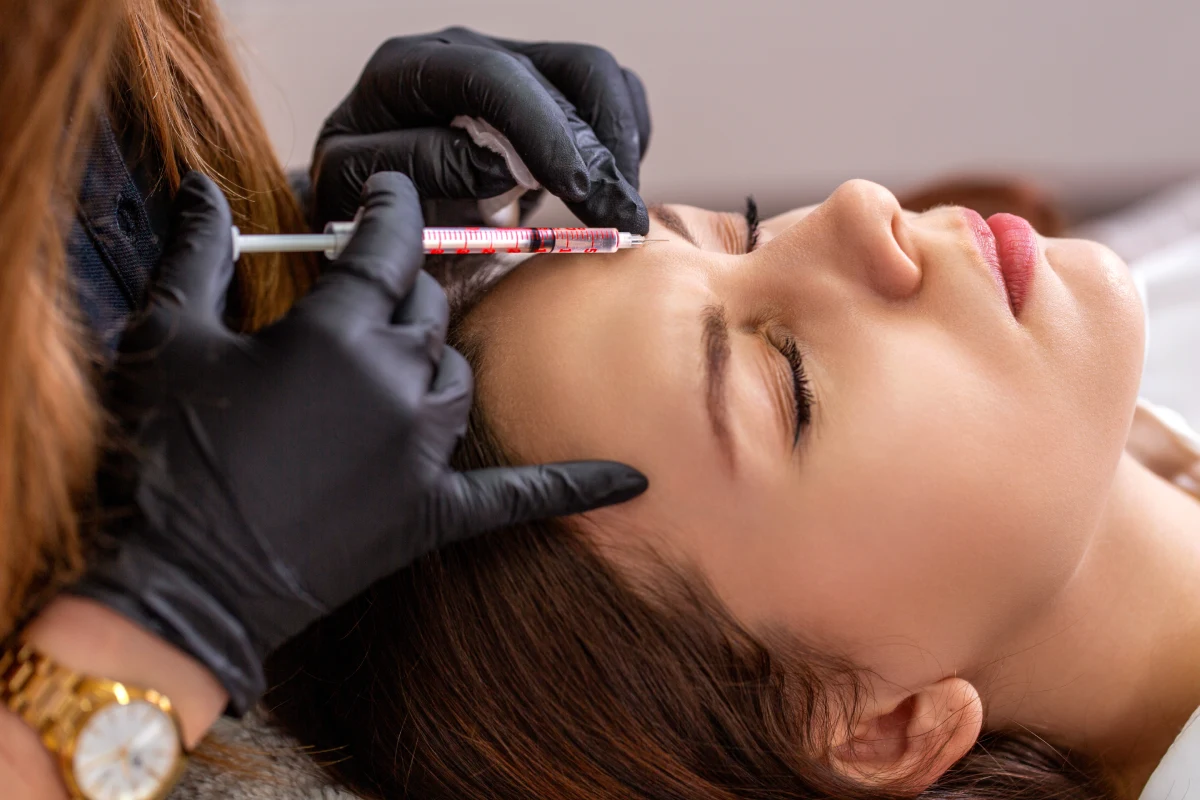
Both products are botulinum toxin type A, which temporarily relaxes the specific muscles that fold the skin each time you raise your brows or smile. With less of that repeated folding, the lines above them soften over the following days, though results are temporary and vary from person to person.
Why Do Forehead Lines and Crow’s Feet Show Up First?
The upper face simply moves more than anywhere else. Raising your brows when you are surprised, smiling at a friend, squinting into afternoon sun: each of those motions folds the skin along the same path.
Repeat that thousands of times a year and the fold stops bouncing back cleanly. Collagen and elastin production slows with age, so skin recovers from each crease a little more slowly than it did at twenty-five.
Lexington’s outdoor seasons quietly add to the total. Bright spring afternoons at Keeneland, long summer rides on the Legacy Trail, and glare off the Bluegrass Parkway all pull the same squint, and that squint is the exact muscle motion that deepens crow’s feet over time.
Dynamic Versus Static Lines, and Why the Difference Decides Your Result
This single distinction predicts your outcome better than anything else.
- Dynamic rhytides are expression lines. They appear when you move and disappear when your face relaxes.
- Static rhytides are resting lines. They stay visible even when your face is completely still.
Neurotoxins work on muscle movement, so they work best on dynamic lines. A line that has become fully etched at rest usually softens with treatment, and softening is a genuine improvement, though it rarely disappears entirely.
You can do a quick test at home. Relax your face completely, hold still for a few seconds, and look. What remains is static. What vanishes is dynamic, and that’s what Botox and Dysport address most directly.
What Do Botox and Dysport Do to Forehead Lines?
Both products temporarily interrupt the signal between nerve and muscle, which reduces how forcefully that muscle contracts.
Across the forehead, the muscle involved is the frontalis, and it has a second job beyond making lines: it lifts your eyebrows. Dosing has to leave enough of that lift intact, which is why managing upper facial wrinkles and eye lines is a question of placement and restraint, not quantity. Too much product in the wrong spot creates a heavy, flat brow.
Most patients see horizontal forehead lines soften within a few days, with fuller change around the two-week mark. Results typically last a few months and vary by individual.
Experienced injectors also treat the forehead and the frown lines between the brows as a related pair. Those muscle groups pull against each other, so treating one without accounting for the other can leave the brow sitting oddly.
What Do Botox and Dysport Do to Crow’s Feet?
Around the eye, the muscle is the orbicularis oculi, and it forms a ring rather than a flat sheet. Injections follow a fan pattern out from the corner of the eye, not a straight row.
Botox injections for crow’s feet aim for a softer, less tired look around the eyes while leaving a genuine smile intact. A well-treated result still crinkles slightly when something is funny, because full stillness in this area reads as unnatural.
Skin here is the thinnest on the face, so depth and placement carry more weight than volume. Patients considering Dysport for wrinkles around the eyes should know that small technique adjustments can produce noticeably different outcomes, which is why injector experience matters more here than in almost any other area.
Botox and Dysport: How They Compare for These Two Areas
Both fall into the same product class. Their differences are practical rather than categorical.
FDA approval status differs.
Botox® Cosmetic is FDA-approved for moderate to severe glabellar lines, lateral canthal lines (crow’s feet), and forehead lines in adults. Dysport® is FDA-approved for moderate to severe glabellar lines. Using it in the forehead or around the eyes is an off-label application, which is common in aesthetic practice and something your injector should discuss with you directly.
Onset tends to differ slightly.
Many patients report seeing Dysport® take effect a little sooner, though individual response varies.
Spread differs.
Dysport® diffuses somewhat more broadly from each injection point, which some injectors find useful across a wide forehead.
Units are not comparable.
Potency units for the two products are measured differently and are not interchangeable, so comparing unit counts between them tells you nothing useful about value.
The honest answer on which product suits you better depends on your muscle pattern, your line depth, and how you have responded to treatment before. That is a conversation, not a web search.
When Neurotoxins Are Not the Whole Answer
Deeply etched static lines sometimes need support beyond muscle relaxation. Resurfacing treatments or, in selected cases, dermal filler can address the crease itself once movement has been calmed.
Crepey texture and sun damage around the eyes respond to different treatments entirely, since neither is caused by muscle activity.
Timing also plays a role. Starting while lines are still dynamic generally gives a better long-term picture than waiting until they have set at rest, which is part of why addressing expression lines through targeted Dysport injections or Botox often begins earlier than patients expect.
Some people should hold off. Neurotoxin treatment is not recommended during pregnancy or breastfeeding, or for patients with certain neuromuscular conditions. A medical history review at consultation sorts this out before scheduling anything.
Ready to Soften the Lines You Notice Most?
If forehead lines or crow’s feet have started showing up in every photo, a consultation is the simplest way to find out which product suits your face and what change is realistic for you. Our team evaluates your muscle movement, talks through your history, and builds a plan to reduce facial aging in Lexington, KY, at a pace that still looks like you.